

How to Create a Point of Interest in Nature Photography Composition


We often hear nature photographers complain: there’s nothing to shoot, the light is bad, if only I had a better lens, then I could take the perfect shot.
The truth is, creating impact in nature photography has far less to do with perfect conditions or expensive gear—and far more to do with how you see the scene in front of you. Strong nature photography composition is about visual decision-making: choosing what matters, eliminating what doesn’t, and guiding the viewer’s eye with intention.
When conditions aren’t ideal—and they rarely are—composition becomes your most powerful creative tool. By learning how to create a clear point of interest, you can transform ordinary scenes into compelling photographs that hold attention and tell a story.
Below are unusual composition techniques professional nature photographers use to create impact, even in difficult light or cluttered environments.
Why Point of Interest Matters in Nature Photography
A point of interest is the visual anchor of your photograph—the element your eye lands on first and returns to. Without it, images often feel confusing, cluttered, or forgettable.
Strong points of interest:
- Provide clarity in complex natural scenes
- Create emotional connection
- Help guide the viewer through the frame
- Increase visual impact and storytelling power
Whether you photograph landscapes, wildlife, or macro subjects, learning how to build a composition around a single point of interest is one of the most valuable skills you can develop as a nature photographer.
#1: Create Leading Lines to Guide the Eye
Leading lines are one of the most effective tools in nature photography composition. They direct the viewer’s gaze through the frame or toward your main subject, creating a sense of depth, movement, and visual flow.
Many photographers struggle to “find” leading lines in nature—but professionals often create them.
Leading lines don’t need to be obvious paths or rivers. With creativity, they can be formed using:
- Tonal contrast (light vs dark)
- Color transitions
- Repeating shapes
- Natural textures
- Even subtle man-made elements
-
Leading line created by tonal contrast between sand and water point to the point of interest, Redwood Forest National Park, California by Jay Patel
-

Converging flow lines used to guide the viewer toward Aldeyjarfoss, Iceland by Jay Patel


A line created by contrast between sand and water, or converging on an waterfalls can all function as powerful leading lines when composed intentionally.
Pro Tip:
When you feel stuck, stop looking for subjects and start looking for direction. Ask yourself: Where does my eye travel in this scene? Then build your composition around that visual movement.
#2: Use a Strong Foreground Element When the Sky Fails You
Nature photographers love dramatic skies—but what happens when the sky is flat, overcast, or uninspiring?
Instead of giving up, shift your focus downward.
Foreground elements can add:
- Depth and scale
- Visual interest
- Context and mood
- A clear entry point into the image
-

Foreground reflections and fall colors take over as point of interest under a clear blue sky, Maroon Bells, Colorado by Jay Patel
-

Foreground geology use as point of interest in this midday shot from Grand Staircase-Escalante National Monument, Utah by Jay Patel
Reflections, rocks, moss, flowers, ice, flowing water, and geological textures all make excellent foreground subjects. Wide-angle lenses allow you to get close and exaggerate foreground presence while still including the broader scene.
When the sky doesn’t demand attention, let something else take the lead.
Composition Strategy:
Fill the bottom third of the frame with a textured or colorful foreground, allowing the background to play a supporting role rather than competing for attention.
#3: Narrow Your Perspective to Discover Hidden Subjects
One of the most effective ways to create a point of interest in nature photography is to narrow your perspective.
Wide scenes can be overwhelming. By using a telephoto or macro lens, you intentionally limit what the viewer sees—and that limitation creates clarity.
In less-than-ideal light, narrowing your field of view allows you to:
- Isolate subtle light and shadow
- Focus on shapes, textures, or patterns
- Eliminate distracting elements
- Create minimalist compositions
-
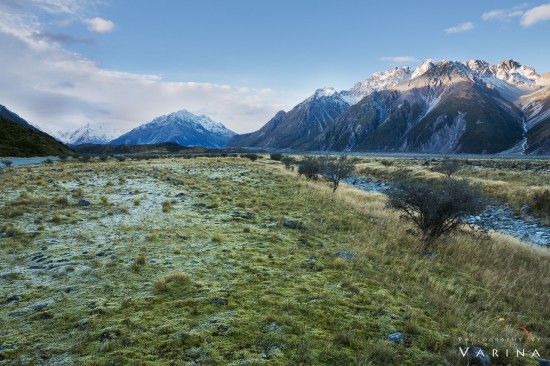
Wide angle lens perspective from of Mt. Cook fails to create a point of interest, New Zealand by Varina Patel
-

Nature photography composition with 70-200 F4L + 1.4x Extender focuses viewers attention on Mt. Cook, New Zealand by Varina Patel
Two photographers can stand ten feet apart and produce entirely different images—one capturing distant mountain light with a telephoto lens, the other focusing on tiny mushrooms at their feet with a macro lens.
The key isn’t location. It’s intentional framing.
#4: Use Size to Isolate Your Subject in Cluttered Scenes
Forests, rainforests, and waterfalls are visually complex environments. One powerful way to create order in chaos is to use size dominance in your composition.
By making your subject appear larger than surrounding elements, you:
- Establish visual hierarchy
- Reduce confusion
- Clearly communicate what matters most
This can be achieved by:
- Moving closer
- Using focal length creatively
- Positioning dominant elements in the foreground
-
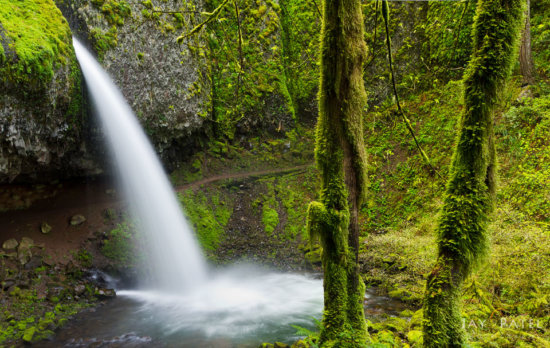
Size of the tree trunks compete with the size of the waterfall, Pony Tails waterfall, Oregon by Jay Patel
-
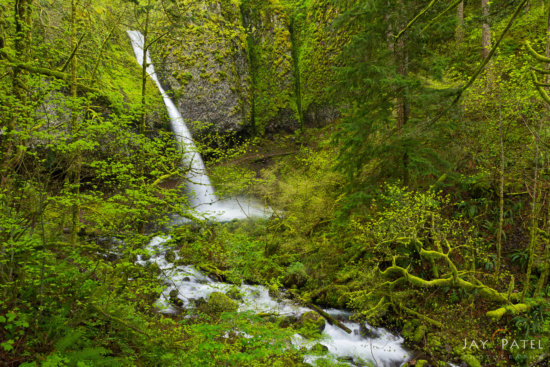
Large waterfall dominates the nature photography composition – Pony Tail Falls, Oregon by Jay Patel
When a waterfall fills more of the frame than surrounding trees—or when foreground trunks frame the scene rather than compete with it—the viewer’s attention is naturally guided where you want it.
Ask Yourself:
What is the most important element in this scene—and how can I make it visually dominant?
#5: Avoid Competing Elements That Steal Attention
Even strong subjects can lose impact when surrounded by distractions.
Competing elements pull the viewer’s eye away from your point of interest and weaken the composition. This is especially critical in wildlife photography, where clean backgrounds dramatically improve visual impact.
Uniform backgrounds—like water, sky, or distant blur—allow the viewer to notice:
- Shape and gesture
- Feather or fur detail
- Subtle action
-

Photography composition with a clean background and a single point of interest in Everglades National Park, Florida by Jay Patel
-
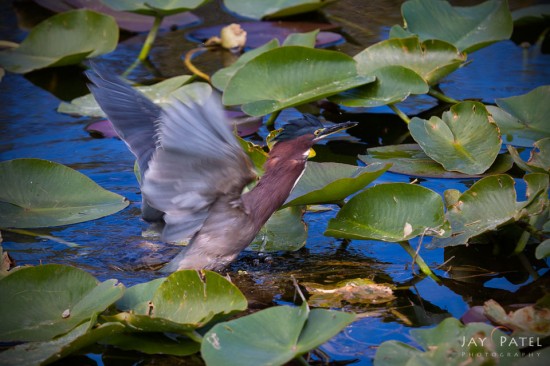
Photography composition with a distracting background Everglades National Park, Florida by Jay Patel
Busy foliage, high-contrast shapes, or intersecting lines can cause your subject to visually disappear.
In the Field Checklist:
- Check edges of the frame
- Watch for bright or high-contrast distractions
- Change position or angle
- Wait for cleaner backgrounds
Simplifying your frame is often more powerful than adding new elements.
#6: Using Color to Simplify Nature Photography Composition
Color is one of the most overlooked tools in nature photography composition.
Analogous color schemes—colors next to each other on the color wheel—create calm, harmonious images with minimal contrast. This makes it easier for your subject to stand out without visual tension.
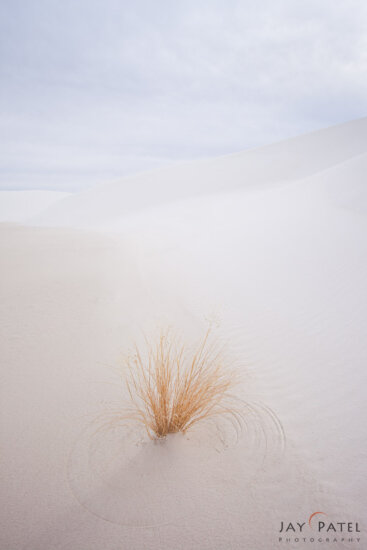
Using muted white background to create point of interest in White Sands National Monument, New Mexico by Jay Patel
A simple palette:
- Reduces distraction
- Creates emotional consistency
- Supports a clear point of interest
When the background and subject share similar tones, separation comes from placement, focus, and subtle contrast rather than harsh visual differences.
#7: Leading the Eye with Focus and Blur
Selective focus is one of the most intuitive ways to create a point of interest.
Our eyes are naturally drawn to sharp detail. When one element is in focus and everything else falls into soft blur, the viewer knows exactly where to look.
Blur doesn’t remove context—it simplifies it.
In macro and close-up nature photography, this technique allows you to:
- Reduce visual noise
- Emphasize texture and detail
- Create mood and intimacy
-
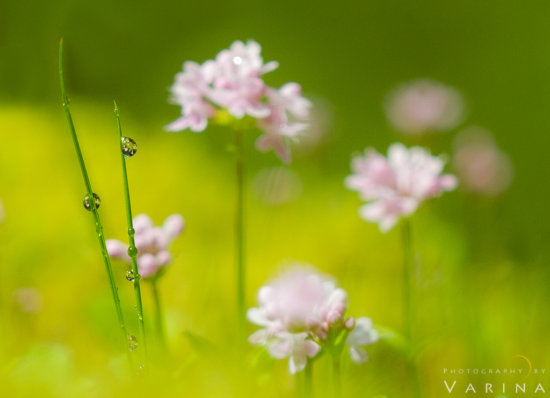
Creating a Point of Interest in Nature Photography Composition using selective blur – Columbia River Gorge, Oregon by Varina Patel
-

Creating Point of Interest using a narrow aperture in Nature Photography Composition – Sunset Beach, Mana Island, Fiji by Jay Patel
Post-processing plays a supporting role here. Subtle color correction, careful sharpening, and removing minor distractions help reinforce the visual hierarchy you established in the field.
Practical Tips to Build a Single Point of Interest
When composing a nature photograph, slow down and identify one primary subject. Then support it intentionally.
Use these techniques:
- Move to eliminate distractions physically
- Use shallow depth of field to blur competing elements
- Create contrast using color, size, tone, or texture
- Use leading lines to direct attention
- Look for patterns—and break them deliberately
A leaf, water droplet, rock, tree, or blade of grass can become compelling when given visual priority.
Strong nature photography composition comes from learning how to see more clearly and simplify complex scenes. If you want step-by-step guidance, check out our in-depth nature photography composition Tutorials that break down composition techniques, visual flow, and simplification strategies you can apply immediately in the field.
Final Thoughts: Seeing Clearly Is the Real Skill
Creating a strong point of interest in nature photography isn’t about rules—it’s about visual intention.
Every strong photograph begins with a simple question:
What do I want the viewer to notice first?
From there, every compositional decision should support that answer.
Learning to simplify scenes, eliminate distractions, and guide the viewer’s eye is a lifelong practice—and one of the most rewarding parts of nature photography.
We hope these techniques help you see familiar landscapes in new ways and create photographs with clarity, impact, and emotional resonance.
 Like
0
Like
0
 Dislike
0
Dislike
0
 Love
0
Love
0
 Funny
0
Funny
0
 Wow
0
Wow
0
 Sad
0
Sad
0
 Angry
0
Angry
0







Comments (0)