

Donald Trump’s craven war on Myanmar

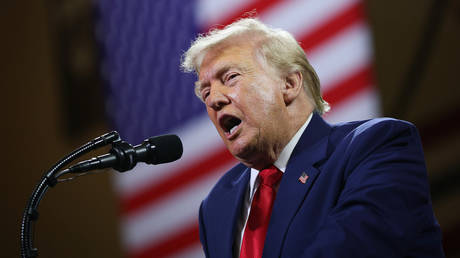
American President Donald Trump has seemingly declared war against the global trading order, post-war liberal internationalism, the North Atlantic Treaty Organization (NATO), Canada, Mexico and a large part of American society, including immigrants, universities, the legal system, the media, Elon Musk, and common sense.
Trump would no doubt be hard-pressed to locate Myanmar, or Burma, on a map, but his administration has declared war on the conflict-stricken country with a series of “reforms” that will endanger humanitarian aid, education, media and governance. And his wrecking ball approach will only benefit the ruling State Administration Council (SAC) junta.
The first salvo was on January 29, when the Department of Government Efficiency (DOGE) cancelled an education initiative, the Diversity and Inclusion Scholarship Program, worth US$45 million to support DEI and to run between 2023-2028.
This would have benefited young scholars from a range of ethnic and religious backgrounds, LGBTQ and refugee communities in and outside Myanmar, sending Myanmar students to study around Asia. Hundreds of students have had funding torn from them, many in mid-study, so abrupt was the cancellation.
Soon after, in a speech, Trump smugly stated, “(w)e also blocked 45 million dollars for diversity scholarships in Burma. 45, that’s a lot of money for diversity scholarships in Burma (scattered laughter from the audience). You can imagine where that money went.”
Trump likely doesn’t care about Myanmar, but that sadistic sniggering was an auger of further punishment to a country he likely knows next to nothing about. American scholarships for Myanmar students, from USAID to the Open Society Foundation (OSF), for over 30 years has immeasurably aided generations of people working in a range of fields.
The board of the prestigious Fulbright Scholarship program resigned on June 11, citing the Trump administration having “usurped the authority of the Board” by denying already selected candidates and subjecting 1,200 other scholarship grantees to an “unauthorized review process.”
The full-scale assault on USAID followed soon after, which spread chaos and uncertainty through multiple Myanmar organizations, refugee camps in Bangladesh and Thailand, the exiled media, women’s groups and many others.
According to US government official statistics, USAID spending on Myanmar was $24 million in 2011, and rose steadily to $237.6 million in 2024. Direct funding from the State Department was $5.4 million in 2011, rising to $46.9 million in 2020 before slowly declining to $4.6 million in 2024.
Roughly half of US aid to Myanmar was humanitarian assistance, then governance and democracy and health programs, amongst others. The projections for 2025 was for $259 million total assistance: 72% of that directed to humanitarian aid for a country experiencing war and natural disasters.
This sharp reduction affects life-saving funding to the World Food Program (WFP) to feed refugees and internally displaced persons inside Myanmar. It severely disrupts health services, including anti-retroviral (ARV) treatment for People Living with HIV (PLHIV).
The administration then went on a rampage in March against Voice of America (VOA) and Radio Free Asia (RFA), including on both their Myanmar language services, which have helped to inform people inside and outside the country for decades. The cuts impacted dozens of other multilingual services informing communities around the world.
Cuts to USAID and concurrent attacks on the National Endowment for Democracy (NED) sent further shockwaves through the media, as these two donors funded directly or through American INGOs, a large number of the exiled media houses. The Myanmar media, essential for transmitting information during the civil war and multiple natural disasters such as the March earthquake, is now in deep crisis.
Next came a ban on travel to America. A Presidential Action Proclamation on June 4 banned citizens from 12 countries, stating, “after accounting for the foreign policy, national security, and counterterrorism objectives of the United States, I have determined to fully restrict and limit the entry of nationals (from Burma).”
The proclamation claimed immigrants from Myanmar abused the system through high rates of visa overstay, but the overall rate compared to other migrant communities was comparatively low. Soon after, the State Department announced that visa interviews for foreign students would be suspended pending “an expansion of required social media screening and vetting.” How much this effects Myanmar students studying in the US is not yet clear.
It’s not as if Myanmar migrants are a particularly destabilizing or threatening community in the US: far from it. There are an estimated 240,000 people from Myanmar in the United States, possibly more, spanning ethnic Bamar, Karen, Chin, Kachin and Rohingya and many more ethnic groups. There are Buddhist monasteries, churches and mosques, and a plethora of various restaurants and Myanmar bodegas.
While many immigrants from Myanmar have historically settled in the state of Indiana, including in Indianapolis and Fort Wayne, they are now also known to be in Los Angeles, Buffalo, and the states of Virginia and Texas. More than 12,000 Karen refugees where resettled to the United States from camps along the Thailand/Myanmar border between 2007 to 2008. Hundreds, if not more, sought sanctuary following the 2021 coup d’etat.
The America-Myanmar relationship is a long and vexed one. The Central Intelligence Agency (CIA) supported an invasion of then Burma by the Kuomintang (KMT) in the 1950s, and had a hand in the rise of the opium economy.
Washington pivoted after the 1962 coup and General Ne Win’s nearly three-decades-long authoritarian rule, supplying over $80 million worth of counter-narcotics aid. But following the brutal suppression of the 1988 uprising, and the formation of the State Peace and Development Council (SLORC), America became military-ruled Myanmar’s greatest international nemesis.
Following Aung San Suu Kyi winning the Nobel Peace Prize, and the post-Cold War Western promotion of democracy and human rights, Myanmar became a bipartisan boutique issue in Washington. Prominent senators such as John McCain visited, meeting Suu Kyi and castigating the SLORC leaders.
So, too, did Madeline Albright, first as United Nations ambassador, then as Bill Clinton’s Secretary of State from 1997 to 2001. The Bush administration worked with Congress to keep Myanmar as a prominent, but largely symbolic, foreign policy project. Over the next decade, tensions arose from the 2007 crackdown on popular protests and the subsequent blocking of aid following Cyclone Nargis in 2008.
Throughout this period following 1988, America was viewed with snarling derision by the Myanmar military, for incendiary criticism of the deplorable human rights situation and persecution of Suu Kyi, financing underground non-violent resistance cells, brainwashing thousands of people through classes on civics and democracy at the American Center, supporting refugees on the border with Thailand, exiled governments in Maryland and orchestrating international criticism of the military and imposing sanctions.
From 2011, the Obama administration sensed a foreign policy win in Myanmar. Two presidential visits balanced support for the Thein Sein administration and longer-term support for Suu Kyi and the National League for Democracy (NLD): this nearly 30-year policy was vindicated with the 2015 election win by Suu Kyi’s party.
 Like
0
Like
0
 Dislike
0
Dislike
0
 Love
0
Love
0
 Funny
0
Funny
0
 Wow
0
Wow
0
 Sad
0
Sad
0
 Angry
0
Angry
0



Comments (0)